Why AmperRank?
Origin Story
AmperRank was born out of two distinct frustrations: the chaotic economics of EV charging, and the absolute meat-grinder that is the 2026 job market.
On the personal side, I’d recently bought an EV and realized that tracking my expenses in Excel was no longer cutting it. I was charging three times as often as I used to get gas, and the price per kWh varied drastically depending on the location, app, and subscription. I wanted a tool that tracked more than just the final price—I wanted insights into time spent and energy added.
On the professional side, I had just been laid off. I wanted to pivot into the renewable energy or automotive sectors, but competing against 2,000+ candidates in seven-stage interview loops meant I was successfully and consistently failing to land a role. I needed a hands-on project to keep my sanity intact and prove my skills in the EV space. Combining my spreadsheet headache with my sudden abundance of free time, I started building AmperRank (or as it was initially called, LogMyVolt).

The Problem
At first, I envisioned a simple expense tracker—just log the cost, kWh, and time consumed, and call it a day. But as I started integrating AI tools to accelerate my workflow, I decided to take the guardrails off the app's scope entirely. What began as a basic log quickly morphed into a robust platform tracking locations, operators, and deep-dive statistics.
As I dug deeper into the data, the real problem revealed itself. I started uncovering the hidden complexities of EV charging that the industry likes to gloss over: the true effective cost per kWh, real-world charging efficiency, the absolute absurdity of app proliferation, and the pricey reality of network roaming.
My core belief is that EV charging should be seamless. You plug in, it charges, and you pay—either automatically or with a simple tap of a credit card. You shouldn’t need a dedicated folder of 40 different apps on your phone, five monthly subscriptions, and a deck of RFID cards in your wallet just to get around.
Unfortunately, those apps aren't going anywhere. Unless you’re willing to get ripped off by premium roaming rates, playing that exact game of app-and-card gymnastics is the only way to find the best prices.
That’s the chaos AmperRank is built to solve. It is designed to untangle the fragmented, frustrating reality of EV charging, so you can finally take back control of your wallet and your time.
The kWh Cost Illusion: Why "Cheap" Rates Are Misleading
Providers love to lure you in with seemingly low rates—like 39 cents per kWh—coupled with a "small" monthly subscription fee of €11.99. But as you can see in the screenshot, this advertised rate is a mathematical illusion. Your true, effective cost per kWh is always higher once that base fee is divided across your actual usage.
The trap is the break-even point. For instance, to actually save money over a standard rate on the plan shown, you must charge above 71 kWh in a single month. This sounds achievable until you look at standard driving habits. The average person in Europe doesn’t travel more than 900 km a month, which requires roughly 180 kWh of energy. If you do 80% of your charging at home, you are only consuming about 36 kWh on the go.
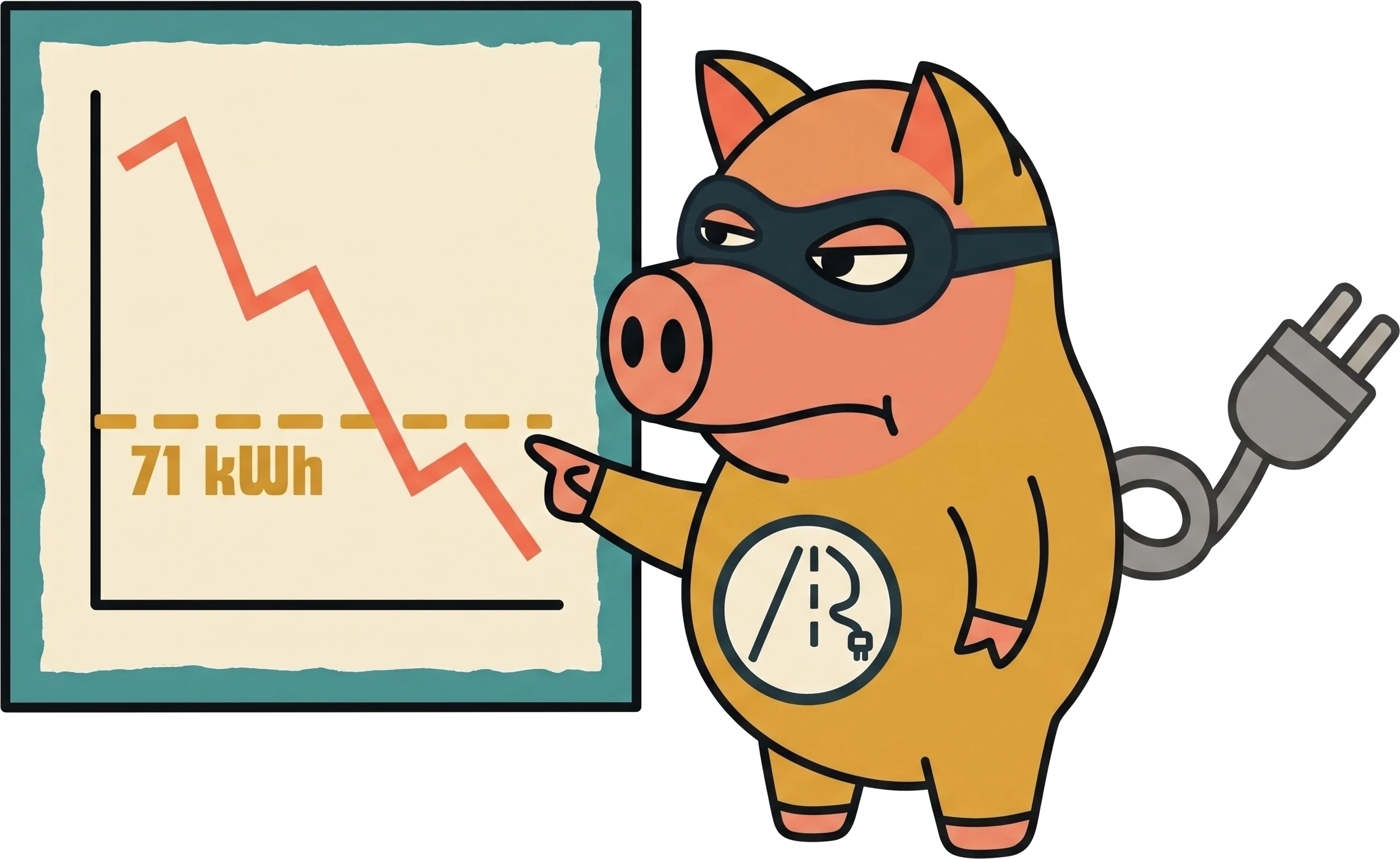
At just 36 kWh of public charging, you fall well short of that 71 kWh threshold. Your effective rate skyrockets, leaving you paying significantly more than you would on a standard, subscription-free rate. AmperRank cuts through the marketing by automatically plotting your effective rate curve, revealing your exact break-even point so you can instantly see if a plan is actually working for your wallet.
The Time-Based Trap
Providers don't just use subscriptions to mask high prices; they also use the clock. Many tariffs double-charge you by billing per kWh and per minute of charging, particularly on AC (slow) chargers.
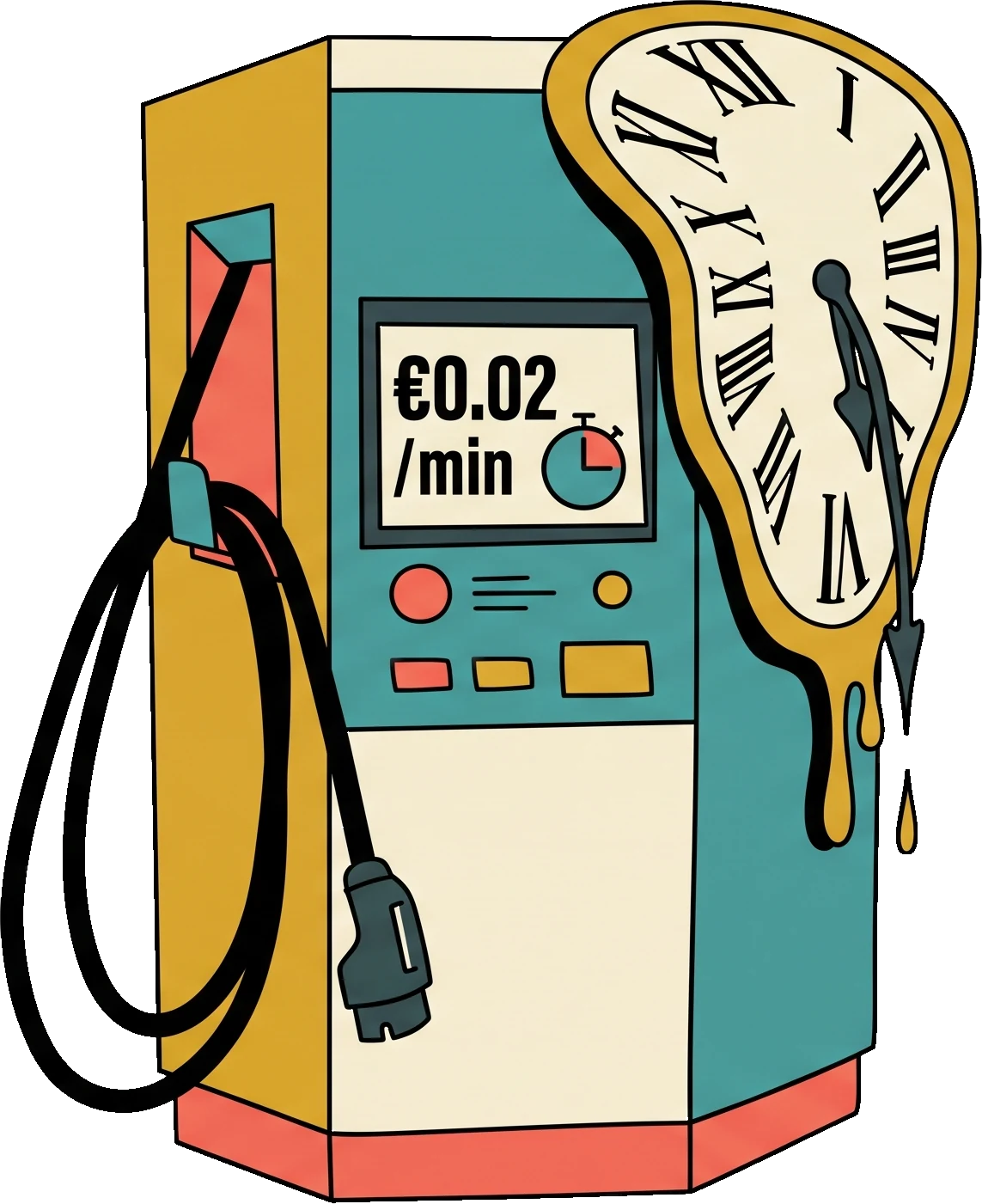
A rate of 49 cents per kWh with just "2 cents extra per minute" looks innocent enough until you actually do the math. Most cars max out at an 11 kW AC charging speed, meaning you pull in 11 kWh over the course of an hour. At 2 cents a minute, those 60 minutes add a stealthy €1.20 to your session. Divide that by the 11 kWh you received, and you're paying an extra 11 cents per kWh. Suddenly, that "cheap" 49-cent rate is effectively 60 cents—a massive 22% markup.
And if you're trying to charge to 100% before a road trip? Prepare to get ripped off. As a battery fills up, the charging speed slows to a crawl, often dipping below 5 kW. Since the clock is still ticking while the energy trickles in, your effective cost per kWh shoots through the roof.
The Efficiency Gap: Paying for Energy You Don’t Get
Have you ever noticed that a charging station often bills you for more energy than your battery actually receives? Your car might report taking in 40 kWh, but the receipt from the DC fast charger bills you for 42 kWh.
This "missing" energy is normal and expected. When you fast-charge, a significant chunk of power is diverted to cooling the battery and the cables—energy that never reaches your drivetrain, but that you still have to pay for. On the flip side, charging at a snail's pace from a standard household socket is wasteful too, because your car's onboard computer stays awake and drains power for hours on end. The actual sweet spot for efficiency usually sits between 11 kW and 50 kW, typically found when using a wallbox or a slower DC charger.

While some efficiency loss is unavoidable, extreme losses are a red flag. With the AmperRank app, you can track the true efficiency of every single session. By comparing the energy you were billed for against the energy your battery actually secured, you can immediately spot which stations operate normally, and which ones are bleeding your money to abnormal energy losses—so you can avoid them next time.
The Roaming Rip-Off: The Illusion of Massive Coverage

EV charging networks love to boast about their footprint. They will show you a map of Europe absolutely smothered in pins and promise a stress-free reality: "Just use our app, and you’ll never have to worry about fragmented charging again."
What they hide in the fine print is that their competitive, advertised rates only apply to a tiny fraction of those pins—the chargers they actually own. The rest are "partner" networks.
But despite the cozy name, these "partners" aren't doing you any favors. In this equation, you aren't a partner at all; you’re just a target getting hit with exorbitant, unadvertised roaming fees.
AmperRank was built to bring transparency back to the map. The app strips away the marketing fluff so you can see an operator’s true native footprint versus their inflated roaming map. Even better, it highlights the honest roaming agreements where you actually get "rate-at-home" or local-network pricing—allowing you to expand your driving range without accidentally draining your wallet.

The Broken Dream of Seamless Charging
In an ideal world, EV charging would be as simple as pumping gas: you pull up, plug in, and tap your credit card. No apps, no subscriptions, just seamless, contactless payment. Sadly, the industry is fighting that reality tooth and nail.
Yes, you can theoretically just tap your card now. Thanks to the EU’s Alternative Fuels Infrastructure Regulation (AFIR) that took effect in April 2024, new fast chargers must include a standard debit or credit card terminal. But the charging networks found a loophole: the "ad-hoc" penalty. If you dare to use that convenient credit card reader, you will almost always be slapped with significantly higher rates. To avoid getting price-gouged, you are forced right back into the app ecosystem—and depending on your route, you might need a dozen of them just to get a fair price.
AmperRank—which, yes, is ironically another app—is designed to cut through this maze. Instead of trying to be a middleman that clips a commission fee on your charging sessions, AmperRank acts as an unbiased guide. It helps you instantly discover which networks are around you, exposes their true pricing, and then directs you straight to the correct native app to get the best rate.
No Garage? Surviving the Urban Charging Penalty
It’s easy for the industry to claim that EVs are inherently cheaper to run—if they assume everyone has a private driveway, a smart wallbox, and a rooftop solar array. But what if you live in an apartment? When you rely 100% on public infrastructure, the financial appeal of an EV can vanish almost overnight.
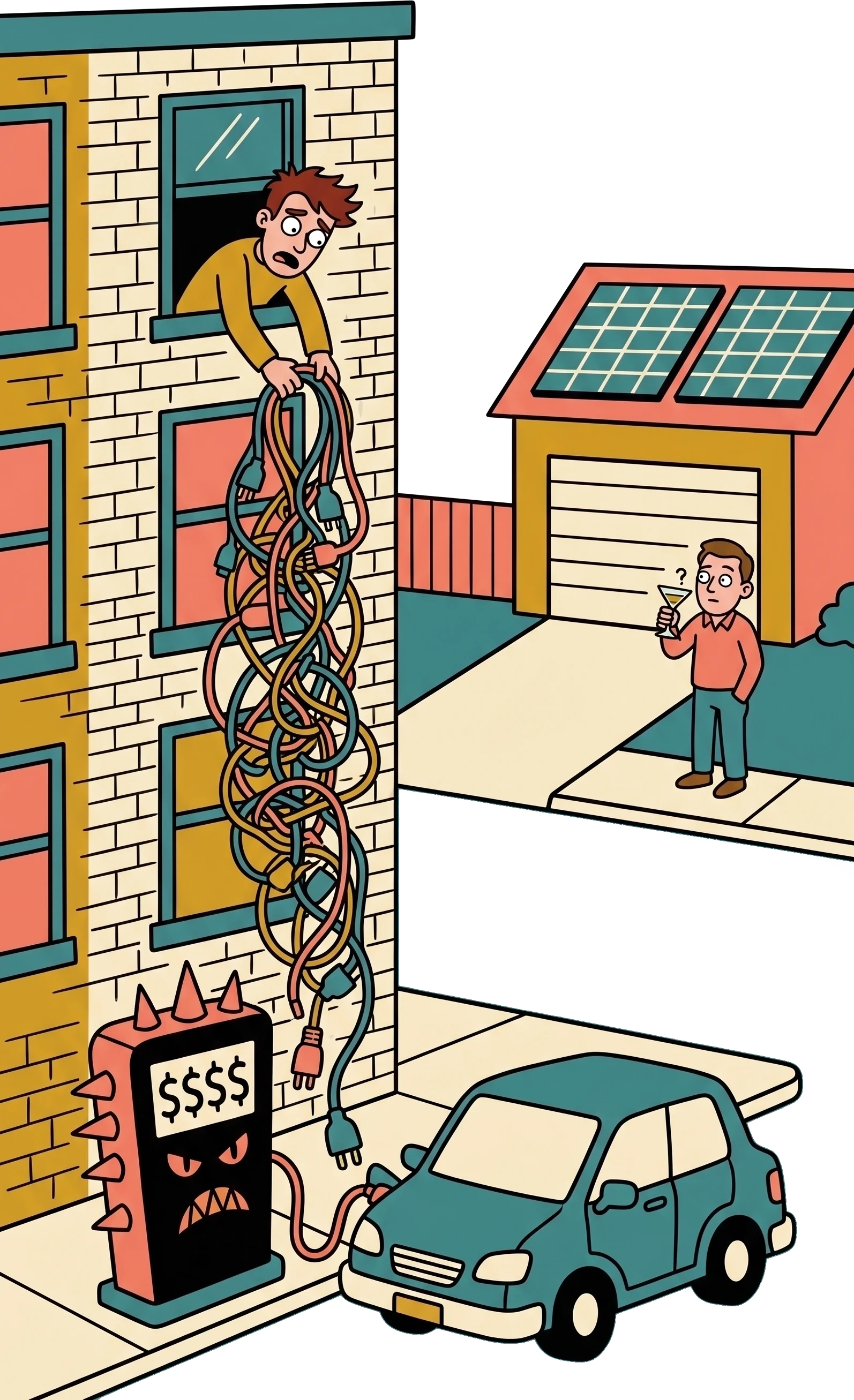
Without a home charger, you are entirely at the mercy of the public grid. And as we’ve already established, that grid is a minefield of time-based penalties, roaming rip-offs, and subscription traps.
AmperRank is built to make EV ownership financially viable, even if you park on the street. The app empowers you to aggressively minimize your costs by tracking your sessions, comparing networks, and discovering the best true rates in your specific neighborhood. That AC charger right outside your apartment building might look convenient, but AmperRank will show you if you're being quietly gouged to use it. It might even reveal that a DC fast charger a kilometer away—right next to the supermarket you already visit—offers a drastically better effective rate, letting you top up faster and cheaper.
Yes, Manual Tracking is a P.I.T.A. (But It’s Worth It)
Let's be brutally honest: right now, the AmperRank app is a bit of a pain, much like starting a new calorie tracker. At first, you might feel overwhelmed by the sheer amount of data you need to log for a single session: location, charging network, kWh billed versus kWh actually added, start and end times, starting and ending State of Charge (SoC), and your odometer reading. It is a meticulous, cumbersome amount of data to enter manually.
But just like a calorie tracker, AmperRank gets progressively smarter and easier to use. It learns your habits, remembers your settings, and begins pre-filling data based on your GPS location. And if you forget to log a session in the moment? You can always drop the data in later.
Ultimately, this manual effort pays massive dividends at the end of the month. In exchange for tapping in those numbers, you get total visibility into where your money is actually going. You get the hard data to back up all the insights we’ve talked about: your exact subscription break-even points, your true charging efficiency, and your bottom-line cost per kWh across all the operators you used.
AmperRank is still in its early stages, and the user experience is constantly being refined. I am continuously exploring ways to simplify data collection, including potential automated integrations. For now, the current manual tracking approach remains the most effective way to gain total visibility into your charging costs and take back control of your wallet.
Not Into Tracking? Use AmperRank Web Instead
Let's face it: maybe the tracking app isn't for you. Maybe you aren’t ready to commit to logging every single charge, and you just want to know the best operator deal in your area without the homework.
For that exact reason, I built the AmperRank Web.

The website is a completely different beast—it puts the ranking first. While it drops the personalized tracking metrics, it gives you a high-level, bird's-eye view of the market. You can instantly see which operators offer the best rates near you, map out which networks are dominant before you head abroad, and verify their actual roaming coverage.
Best of all, if you don’t even own an EV yet and are still on the fence, the website features an advanced EV Assessment Calculator. You can input your driving habits to see what kind of EV fits your lifestyle, calculate your projected monthly operating costs, and map out realistic ranges—all before spending a single euro.

The Road Ahead
AmperRank is a work in progress, but the core philosophy is permanently set: EV drivers shouldn't be penalized just for trying to charge their cars. Moving forward, the goal isn't necessarily to just stack up new features, but to leverage our data to drive industry-wide prices down through raw, undeniable transparency. Of course, keeping this tool alive means eventually finding a sustainable business model. The road ahead involves exploring novel, out-of-the-box ideas to keep the servers running—ensuring that when AmperRank does monetize, it does so by creating value for the broader ecosystem, never by gouging the driver.